- textdump
- Posts
- The Controlled Environment of Little Rocket Lab
The Controlled Environment of Little Rocket Lab
Fixing a world that doesn't need fixing.

Patrick Dubuque
October 27, 2025
I have a dirty secret: I like to clean other people’s houses. Occasionally, when I’m housesitting for someone for an extended period of time, I’ll just… tidy up for them a little bit. I’m not a monster. I don’t wreck their systems when it’s obvious they have a system in place. I don’t put things away in places they won’t find. I certainly don’t go into their drawers or anything like that. But if things are a mess, I’ll just organize a little, since I’m there anyway. Sure, I clean my own house as well, sometimes, but it’s not the same. For one thing: At home, there’s always something else to do, something to write or someone to love. Housesitting is a sort of detached time, like airports and train rides, and it’s easier to be gracious with sunk time. And the other: When I clean my house, I have to watch it get dirty again. I see my two kids lay waste to my efforts like the waves beating at the cliffside. When it’s someone else’s mess I can walk out the door and maintain it in my memory forever. Something that can live after me, in my own mind.
Few genres of video game make me more excited to install than the factory simulation. Production lines, conveyor belts, bottlenecks, tech trees: Every menu, every statistic whispers a promise to my brain. There is a mess, or rather, a need, and only I can put in the time and the work and the strategy to make things right. Few genres of video game make me uninstall them so quickly afterward, because as alluring as the factory genre is, I’m really terrible at them.
Enter Little Rocket Lab, the debut game from developer Teenage Astronaut, released to Steam and GamePass early in October. You play as Morgan, a young woman who is returning to a hometown fallen on hard times, a decade after the death of her mother. You’ve moved back in with your aunt to resume the work she began: To build a rocket in the silo in her backyard. In order to do so you’ll have to enlist the help of the townsfolk to research blueprints and unlock new technology, convert raw materials into parts, create new machines that turn those parts into more complicated parts, and fund improvements to your property. All the while, you’ll also invigorate the town, both materially through improvements and, naturally, the brilliance of your spirit, rallying folks to start dreaming again.

That’s a lot of words to say “Stardew Valley meets Factorio,” because just summarizing it like that would be crass. The inspirations are undeniable, however, from the minimalistic gift-based friendship system (though, mercifully, without transactional romance) and unapologetic pastoral setting. It’s almost too nice of a town. The game’s narrative theme, of the uplifting nature of productivity, would have been more powerful if the town of St. Ambroise had looked a little more run down and hopeless when Morgan returns home: potholes, flickering lights, decaying infrastructure. Early in the game you do repair a bridge, and the characters reflect that they’d given up making more permanent solutions, but everything is still just a little too picturesque, flowers in the windowsills, etc. If we’re here to clean up, it may as well be a mess.
It wouldn’t have worked that way, of course, because of that crucial first hour, where video games have to survive the refund window. Combining an ugly rust-belt town, a downer opening about grief and loss, and some counterintuitive and disempowering mechanics would not be what the marketing experts call “putting one’s best foot forward,” even while the narrative experts would absolutely call it that. Beyond just that, a struggling St. Ambroise would conflict with the game’s self-selected niche. Little Rocket Lab is, after all, going to be treated as an entry in the cozy games market, and that entails certain expectations from the audience.
The rise of the cozy game is well documented at this point, so a quick summary: It offers a world where the player wants to live. That means pleasant, warm aesthetics, but it also means failure-resistant, low-stakes gameplay where progress is slowly advancing and never really at risk. In other words, the original cozy game is clearly Dragon Quest I.
Cozy games can still have emotional weight, despite their pastel facade—Spiritfarer is about letting go of your loved ones, even as you harvest falling stars and bake cookies—and Little Rocket Lab doesn’t shy away from the presence of Morgan’s mother, whose gravestone sits on a hill above the town. It’s all too easy for coziness to become whitewashing, but even for a developer seeking to avoid it, the necessary simplification of the world can make it a challenge. All fiction is using fake people to say real things, but the secret is that the places are always real, too. Seventeenth century London is London, and Winesburg OH is the actual Clyde OH. If the author fails at that, the reader will never believe in the characters living there.
It’s a demand that video games can almost never really accomplish. Even Dragon Quest’s towns were stocked with dozens of people wandering around, and only two homes. Every once in a while a big-budget game will take an interest in modeling an entire neighborhood that feels real and lived: Shenmue, famously, and also the likes of Persona 5 and Disco Elysium. Most of the time, however, the real world has to take place behind locked doors and inaccessible areas, all the day-to-day life happening just offscreen. You have no choice but to kill the part of the brain that asks “How do these people eat?” In a book or a movie, it’s easy to do that: You can’t wander off the page where the story’s happening. In a video game you can step outside the narrative and wander around town, wondering how the economy works.
And, unfairly or not, this problem is particularly notable in Little Rocket Town, because it’s a game about economies. And this is where the game’s two genres start to chafe, because factory games, despite their lack of fail states, are anything but cozy. Entries in the genre are traditionally compelled to decide whether to handwave away the mechanical aspects of capitalism or smirk knowingly about them. But lines of coal and ore cutting through peaceful meadows, cranes and power lines scarring the sidewalks of town, chemical plants spread across the beach like a beached and rotting whale—it’s jarring, and unintentionally hilarious. The townspeople not only accept this miniature industrial revolution, they welcome it into their own homes, asking you to set up steel and plastics factories that run through their own bedrooms. All for the sake of progress. All for the sake of the rocket.
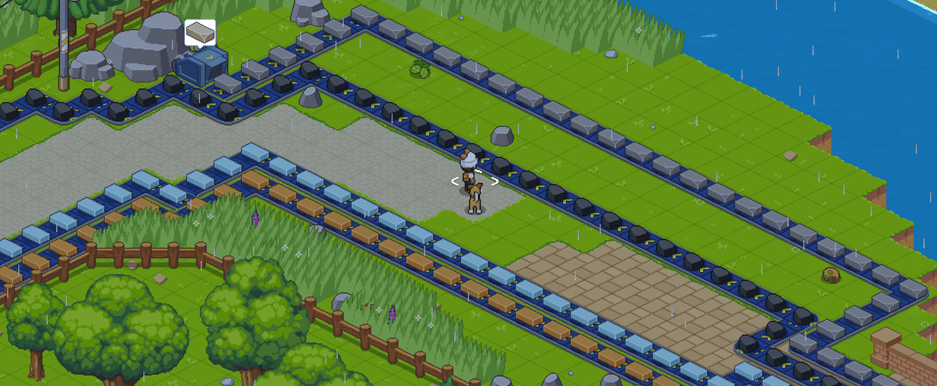
You’re cleaning up the town, but it’s hard not to feel like you’re making an even bigger mess.
The other sense of discordance comes from the work itself. St. Ambroise is a dying town, but it’s also a paradise; everyone gets along, everyone has a house, society has no real issues beyond missing a certain amount of job satisfaction. The character interactions Morgan has with the two dozen residents are legitimately charming and well-written, despite some limitations owing to the game’s smaller scale. There are no cutscenes, no major character development; how could you, when everyone’s already fine? But it almost doesn’t matter, because it’s hard to feel allowed to take the day off to hang out with them. In spite of a very deliberate decision to eliminate a sense of mechanical time pressure—the game proceeds in acts corresponding with the construction of the titular rocket, but the days themselves are unnumbered and the days of the week only affect store closures—the factory line still throbs in pain when something goes wrong. This is what makes factory games fun, and also what makes them stressful as hell. There is always something broken, and fixing it will always break something else. Your drills run out of ore. A new technology requires a part you stopped building because you didn’t think you needed it anymore. Who has time to check in with the local baker, see how he’s doing? There’s work to be done, always, every moment, and if not then you’re running to get to bed before midnight, or else you’ll lose four hours the next day.
Little Rocket Lab is a good game. If it weren’t, none of these sources of aesthetic and mechanical friction would matter; no one cares if bad art is honest. Its isometric pixel art is pleasant, the characters are likeable, the factory aspect is challenging to manage while rarely feeling overwhelming. (OK, it’s sometimes overwhelming; nothing is as disempowering as realizing you have to knock everything down and start over again, because you laid out your factories in the wrong way and can’t reach them with your raw materials.) It doesn’t overstay its welcome. If you’re someone who wants to, and often struggles to, enjoy factory-style games, it does the job well.

Ultimately, though, it comes back to St. Ambroise, and the cliché of setting as character. Despite their differences, the Venn diagram of coziness and the factory genre overlap at a sense of productivity. It’s no wonder that this style of game, most notably Animal Crossing, exploded in popularity during the pandemic: When everything else was falling apart, it felt good to find a tiny pocket of the world, even a digital one, and improve it. It’s the same sense of empowerment that made Dragon Quest I and RPGs attractive, as well as every skill-based game. And practicing the guitar, if we want to be honest, and making art and volunteering at the food bank. If some games want to feel like slot machines, these games want to feel like raising children, minus nearly every aspect of having children: a quick burst of endorphins over making something better. A sense of control.
It’s a shame, then, that St. Ambroise never feels like it needs our help. Nor do the people in it. There’s nothing to clean. You build a rocket, watch it sail into the sky towards… the game never really says. Which is strange: all this work, all this production, to make something that doesn’t actually do anything. As the credits roll, it flies off screen, into a part of the story we can’t see. Maybe the next game will take us there.